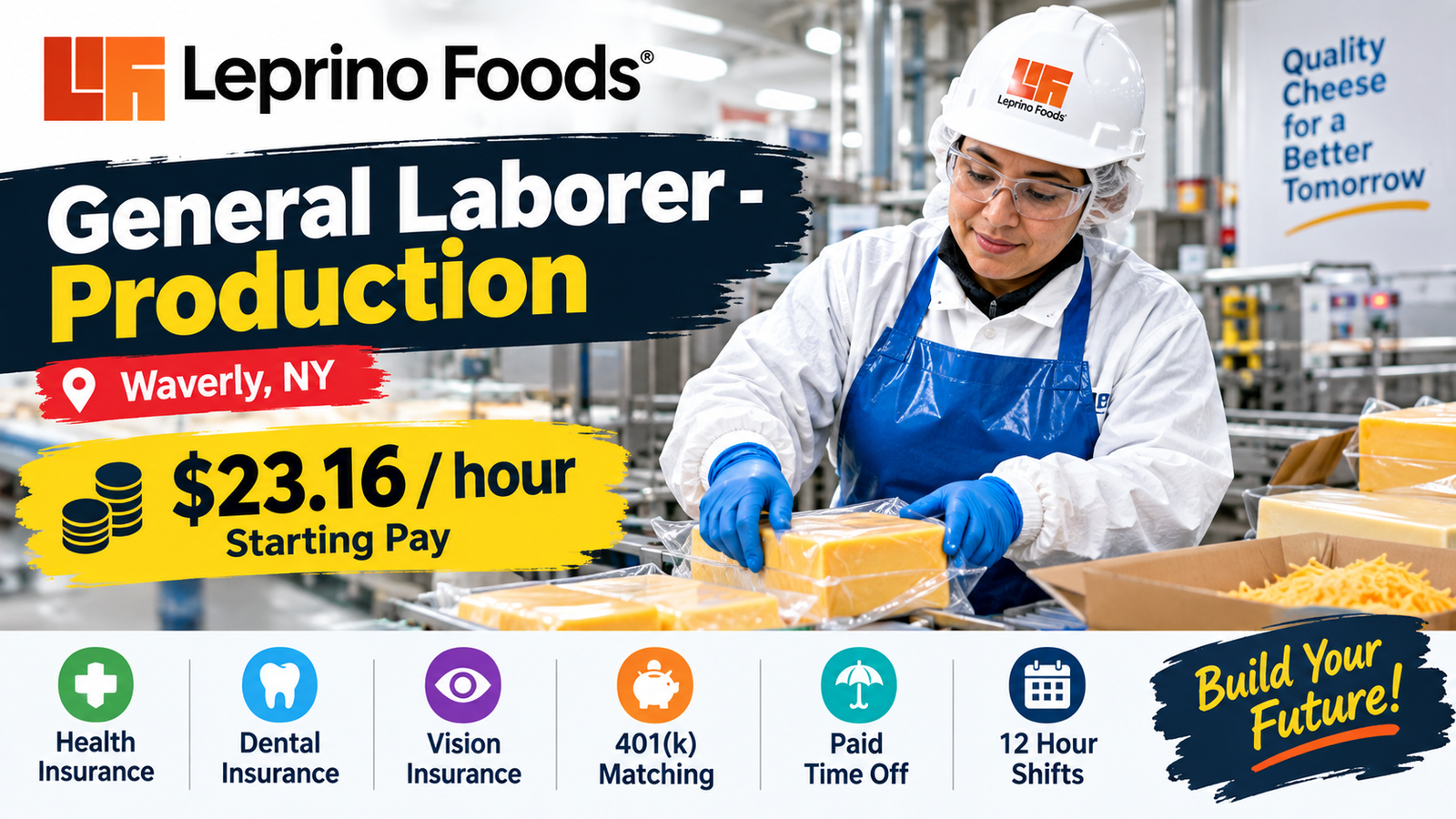
If you are looking for an entry-level production job in the USA, the General Laborer – Production position at Leprino Foods in Waverly, New York is one job that may be worth understanding in detail.
This position is based at the company’s Waverly facility and is part of its production operations. The listed pay is $23.16 per hour, and the job also offers benefits such as health insurance, dental insurance, vision insurance, life insurance, paid time off, a 401(k), 401(k) matching, and a health savings account.
But the salary is not the only thing that stands out.
This is a 24/7 manufacturing facility, so employees must be prepared to work different schedules, including day shifts, night shifts, weekends, holidays, and overtime when required. The normal schedule described in the job posting is based on 12-hour shifts using a 2-2-3 rotation. One of the benefits of this type of schedule is that employees can have every other weekend off after the schedule is established.
The position is described as an entry-level general labor production role. However, that does not mean the work is easy or that no skills are required.
The employee will work around food production and packaging equipment, inspect cheese products, package cheese into bulk totes, operate a sealing machine, clean and sanitize equipment, use computer systems, record production information, maintain packaging materials, and follow strict safety and sanitation procedures.
The job also requires employees to work in a wet environment with loud noise and varying temperatures. High heat and humidity can be part of the working conditions, especially during sanitation duties.
Because of this, someone considering this job should understand the complete working environment rather than looking only at the $23.16 hourly wage.
In this article, we will explain the Leprino Foods General Laborer – Production job in simple terms, including salary, schedule, overtime, shift differentials, responsibilities, qualifications, physical requirements, benefits, training, career advancement, and my personal opinion about the opportunity.
Leprino Foods General Laborer Job Overview
The position is listed as General Laborer – Production at Leprino Foods in Waverly, New York.
The job has a production-related function and is connected to bulk cheese packaging and manufacturing operations.
The listing identifies the position as an entry-level opportunity. New employees are expected to learn different operator roles within the facility, which can potentially help them move into more skilled positions over time.
Important Job Details
Job Detail
Information
Company
Leprino Foods
Job Title
General Laborer – Production
Location
Waverly, NY 14892
Requisition ID
31562
Job Function
Production Operations
Openings
15
Pay
$23.16 per hour
Evening Differential
$0.75 per hour
Weekend Differential
$1.00 per hour
Job Type
Full-time
Work Schedule
12-hour shifts
Rotation
2-2-3 rotation
Facility
24/7 operation
Work Setting
In person
Experience
Food industry experience preferred
Minimum Age
18 years
Overtime
Required when needed
Weekends
Required
Holidays
Required
Training
Learn additional operator roles
Career Growth
Advancement opportunities
The job posting states that there are 15 openings.
That can be useful for applicants because it indicates that the company is hiring multiple people for this production operation.
However, applicants should always check the current status of the listing before applying because the number of available positions can change.
How Much Does the Leprino Foods General Laborer Job Pay?
The listed base pay for this position is:
$23.16 per hour
The job also includes additional pay differentials.
Employees receive a $0.75 evening pay differential for every evening hour worked between 6:00 PM and 6:00 AM.
There is also a $1.00 weekend pay differential for every hour worked on Saturday and Sunday.
This means that the actual hourly earnings can be higher than the basic $23.16 rate when an employee works eligible evening or weekend hours.
For example, the base rate is:
$23.16 per hour
An eligible evening hour would be:
$23.16 + $0.75 = $23.91 per hour
An eligible weekend hour would be:
$23.16 + $1.00 = $24.16 per hour
If an hour qualifies for both differentials, the exact treatment should be confirmed with the employer’s pay policy.
These differentials are important because this facility operates around the clock and employees may be required to work nights and weekends.
What Would $23.16 Per Hour Mean Annually?
If we make a simple calculation using 40 hours per week:
$23.16 × 40 = $926.40 per week
Using 52 weeks:
$926.40 × 52 = $48,172.80 per year
So the basic annualized gross amount would be approximately $48,172.80 if someone worked exactly 40 hours every week at the base rate.
But this is only a basic calculation.
The actual earnings could be different because this job uses 12-hour shifts, overtime may be required, and eligible evening and weekend hours can receive additional pay.
Taxes, insurance contributions, retirement contributions, and other deductions would also affect take-home pay.
Therefore, applicants should not consider $48,172.80 as a guaranteed yearly salary.
What Is the General Laborer – Production Job?
The General Laborer position is connected to bulk packaging production.
The employee helps package cheese and maintain the quality and cleanliness of the production area.
One major part of the job is working with the cheese packaging line.
The employee may inspect the final cheese ribbon, package the product into bulk totes, seal bags, maintain packaging supplies, record production information, and clean equipment.
The job also involves sanitation.
This is important because the facility produces food products.
Food manufacturing requires strict cleanliness procedures. Employees may need to wear full-body protective equipment and use hot sanitizer on machinery and equipment.
Because of this, the employee must be comfortable working in conditions that can involve heat and humidity.
Main Responsibilities of the Job
There are several responsibilities listed for this position.
Understanding them is important because the title “General Laborer” does not fully describe everything the employee will actually do.
Inspecting Cheese Product Quality
One responsibility is inspecting the final cheese ribbon for product quality.
The employee needs to look for problems and report them to the appropriate team lead, supervisor, or manager.
This means the worker is not simply moving products from one place to another.
They have a role in making sure the finished product meets the required quality standards.
Accuracy and attention to detail are therefore important.
Packaging Cheese Into Bulk Totes
The employee will package cheese ribbon into a bulk tote.
This involves handling packaging materials and making sure the product is placed correctly.
The worker will also operate a sealer machine to seal bags.
This requires employees to follow the correct procedure because improper packaging can affect product quality.
Cleaning and Sanitizing Equipment
Cleaning and sanitation are major parts of this position.
The employee must properly clean and sanitize equipment according to company requirements and good manufacturing practices.
This can involve using hot sanitizer and wearing full-body PPE.
The purpose is to maintain a sanitary food production environment.
This part of the job may be physically uncomfortable because the company specifically says employees must be capable of working in high heat and humidity.
Someone applying should understand this before accepting the position.
Using a Computer System
Another interesting part of the job is computer use.
The employee will use a Manufacturing Execution System, or MES, on a computer to generate labels and track products.
This means the job is not completely manual.
Workers need some basic computer knowledge and must be comfortable entering or checking production information.
The listing also mentions Microsoft Office knowledge.
Therefore, basic computer skills can be useful even in a production job.
Recording Production Information
Employees are responsible for documenting information such as:
Lot numbers
Pallet numbers
Number of bags
Number of boxes
Number of liners used during the shift
This information is consolidated at the end of the production run.
This part of the job requires accuracy.
A mistake in production records can create problems for tracking and inventory, especially in a food manufacturing environment.
Maintaining Packaging Materials
The employee needs to maintain a supply of boxes on the packaging line.
They also need to inspect packaging materials for defects.
If a problem is found, it must be reported to the appropriate supervisor or team lead.
This is another reason attention to detail is important.
Understanding the 2-2-3 Work Schedule
One of the biggest things applicants should understand about this job is the schedule.
Leprino Foods describes its Waverly facility as a 24/7 operation.
That means production continues throughout the week.
Employees therefore need to be willing to work different shifts.
The schedule is based on 12-hour shifts with a 2-2-3 rotation.
A 2-2-3 schedule generally means an employee works two days, has two days off, then works three days, followed by another period of days off, depending on the rotation.
The exact calendar can vary according to the company’s schedule.
One important advantage mentioned in the job description is that this rotation allows employees to have every other weekend off.
However, applicants should not assume that every weekend will be free.
The company clearly states that employees must be able to work weekends and holidays when required.
Are Night Shifts Required?
The answer is that applicants must be willing and able to work days or nights.
The facility operates 24 hours a day, seven days a week.
Therefore, a person applying for this position should not expect a permanent daytime schedule from the beginning.
After training is completed, new employees will be assigned a regular schedule based on the next available shift.
This is important.
If someone can only work Monday through Friday during daytime hours, this position may not be suitable.
On the other hand, someone who is flexible about day and night shifts may have a better chance of adapting to the job.
Evening and Weekend Pay Differentials
The job provides additional pay for certain shifts.
Employees receive a $0.75 evening differential for every eligible evening hour worked between 6:00 PM and 6:00 AM.
There is also a $1.00 weekend differential for every hour worked on Saturday and Sunday.
This means employees who regularly work nights or weekends may earn more than the base hourly rate for eligible hours.
For example, a qualifying evening hour could pay $23.91 instead of $23.16.
A qualifying weekend hour could pay $24.16 instead of $23.16.
The exact payroll treatment should always be confirmed with Leprino Foods because eligibility and the interaction between differentials can depend on company policy.
Is Overtime Available?
The job listing mentions overtime as part of the working conditions.
Employees must be willing to work required overtime to support the company’s 24/7 operation.
This means applicants should be prepared for the possibility of working more than their regular scheduled hours.
Overtime can increase total earnings, but it can also make the job more physically demanding.
Someone who wants strict working hours with no possibility of additional shifts should think carefully before applying.
What Qualifications Are Required?
The minimum qualifications are relatively straightforward.
The applicant must be at least 18 years old.
They must also be able to work:
Days
Nights
Weekends
Holidays
Off-shifts
Required overtime
The company also expects employees to work in hot and humid environments.
Another important requirement is accuracy.
The employee must be able to complete work assignments with a high degree of accuracy.
The company also expects new workers to be willing and able to learn other operator positions within the facility.
This last point is important for career growth.
The company is not looking only for someone who wants to perform one simple task forever.
It wants employees who can learn different production roles.
Is Previous Food Industry Experience Required?
Prior food industry experience is listed as preferred.
This means food manufacturing experience can be an advantage, but the provided listing does not present it as an absolute minimum requirement.
Someone who has worked in:
Food production
Food packaging
Manufacturing
Warehouse operations
Production lines
Sanitation
Machine operation
may already understand some of the working environment.
However, a person without food industry experience may still be able to apply because this is described as an entry-level position.
The important thing is to understand that food production has stricter sanitation requirements than many ordinary warehouse or general labor jobs.
Computer Skills Required for This Job
A production worker might not immediately sound like someone who needs computer skills.
But this position does.
The job description says employees should have proficient computer knowledge, including Microsoft Office products.
The employee will also use a Manufacturing Execution System, known as MES, to generate labels and track products.
The listing also mentions SAP or a similar integrated manufacturing system.
A new employee may not already know SAP.
The important part is being able to learn the system.
This is actually a useful skill because modern manufacturing increasingly combines physical production with computer-based tracking.
Why Accuracy Is Important
Accuracy is a major requirement for this position.
Employees need to inspect product quality, track production information, record lot numbers, count packaging materials, generate labels, and follow standard operating procedures.
These tasks require attention.
For example, incorrectly recording a lot number could make it harder to track a product.
Similarly, incorrect labels or packaging can create problems further down the production process.
This is why the company specifically mentions the ability to complete assignments with a high degree of accuracy.
Physical Requirements of the Job
This is not a light office job.
The General Laborer position has several physical requirements.
Employees may need to:
Lift and carry moderate weights
Repeatedly handle materials
Walk frequently
Stand frequently
Climb stairs
Climb ladders where required
Bend
Reach
Work around production equipment
Pass a physical abilities lift test
The listing specifically mentions lifting up to 30 pounds during the physical abilities test.
This does not necessarily mean that every object handled throughout the shift will always weigh exactly 30 pounds.
It means applicants must be capable of meeting the company’s stated physical testing requirement.
Working in Heat and Humidity
One of the most important environmental requirements is the ability to withstand high heat and humidity.
The sanitation process can involve hot sanitizer.
The facility may also have varying temperatures depending on the production area.
This means applicants should not assume that the job will always be in a comfortable climate-controlled environment.
The company clearly tells applicants that heat and humidity are part of the job.
In my opinion, this is something people should take seriously.
A person who struggles with hot and humid working conditions may find this job difficult even if they like the pay.
Wet Floors and Loud Noise
The working environment can also include wet or slippery areas and loud noise.
The job description says employees will be exposed to a wet/slippery environment with loud noise in varying degrees of temperature.
This is common in some food manufacturing environments because equipment needs to be cleaned and sanitized regularly.
Employees therefore need to follow safety procedures carefully.
Appropriate PPE will be required based on the employee’s role and location.
Personal Protective Equipment
Employees working in manufacturing facilities must use Personal Protective Equipment, or PPE, according to the requirements of their specific role.
For this particular position, the job description mentions full-body protective equipment during sanitation work.
PPE can help protect employees from workplace hazards.
Applicants should be prepared to follow PPE requirements even if the equipment feels uncomfortable at first.
Safety rules in a food manufacturing facility should be treated seriously.
Benefits Offered by Leprino Foods
The listed benefits are another important part of this job.
The job posting includes:
401(k)
401(k) matching
Health insurance
Dental insurance
Vision insurance
Life insurance
Paid time off
Health savings account
These benefits can add significant value to the total employment package.
401(k) and Matching
The position includes a 401(k) and 401(k) matching.
A 401(k) can help employees save for retirement through payroll contributions.
Employer matching can be particularly valuable because the company may contribute additional money based on employee contributions and the terms of its plan.
Applicants should ask Leprino Foods about the exact matching formula, eligibility requirements, vesting rules, and contribution limits.
The job advertisement itself does not provide those details.
Health Insurance
Health insurance is also listed.
Healthcare is an important consideration when comparing jobs in the USA.
An applicant should look at not only whether insurance is offered but also how much the employee contributes and what the plan covers.
Questions about deductibles, premiums, copays, and eligibility should be discussed with the employer.
Dental and Vision Insurance
The job also includes dental and vision insurance.
These benefits can help employees manage eligible dental and vision expenses according to the company’s plans.
Again, exact coverage depends on the plan.
Health Savings Account
A health savings account, or HSA, is also listed.
An HSA can be used for eligible healthcare expenses when the employee meets the applicable requirements.
The exact details depend on the health plan and company benefits structure.
Life Insurance
Life insurance is included among the listed benefits.
The exact amount of coverage should be confirmed with the employer.
Paid Time Off
Paid time off is another listed benefit.
This can be valuable because employees can potentially take approved time away from work while receiving pay according to company policy.
The listing does not specify the exact number of PTO days.
Career Advancement at Leprino Foods
One of the more positive parts of this job is that it is described as an entry-level role where employees are expected to learn various operator positions.
This means the company appears to view the role as more than just a single basic production task.
The employee can potentially learn other positions within the Waverly facility.
Learning additional operator roles can make a worker more versatile.
Over time, experience in different parts of production may help an employee qualify for other opportunities within the company.
However, applicants should understand that advancement is not automatic.
A promotion generally depends on performance, attendance, skills, available positions, company needs, and other factors.
The best way to take advantage of advancement opportunities is to learn the current job properly and then become capable of handling additional responsibilities.
Why Learning Multiple Operator Roles Matters
In a manufacturing environment, employees who can perform more than one task can become more valuable to the production team.
For example, a worker who understands packaging, sanitation, product inspection, computer tracking, and another operator position may have a broader understanding of the production process.
This can help build a stronger resume.
It also gives the employee practical experience that may be useful for future manufacturing positions.
For an entry-level worker, this can be more valuable than simply doing one repetitive task for several years.
Food Manufacturing Is Different From Regular General Labor
The word “General Laborer” can make this job sound similar to any warehouse or factory job.
But food manufacturing has additional responsibilities.
The employee is working with food products.
That means sanitation, product quality, traceability, packaging, and hygiene are extremely important.
Employees need to follow standard operating procedures and company policies.
They also need to keep the production area clean.
This is why the job includes sanitation responsibilities in addition to packaging.
Standard Operating Procedures
The employee is expected to perform duties according to established Standard Operating Procedures, commonly called SOPs.
SOPs provide specific instructions for how tasks should be completed.
In a food production environment, following SOPs can help maintain consistency, safety, and product quality.
A good employee should be comfortable working according to established procedures rather than trying to improvise every task.
Safety Responsibilities
Safety is another major part of the position.
Employees must follow proper safety policies and procedures at all times.
This can include:
Using required PPE
Following machine safety procedures
Maintaining awareness around equipment
Following sanitation procedures
Reporting problems
Keeping work areas organized
Following company instructions
Safety is particularly important because the job involves machinery, wet surfaces, heat, physical movement, and potentially slippery areas.
Drug Testing and E-Verify
The job listing also states that Leprino Foods uses Psychemedics for hair follicle drug testing as part of the pre-employment process.
The listing says this involves a 90-day hair follicle drug test.
The company also participates in E-Verify.
Applicants should understand these requirements before moving forward with the hiring process.
The exact procedures and any questions about eligibility should be discussed directly with the employer during the application process.
Who Is a Good Fit for This Job?
In my view, this job could be suitable for someone who is comfortable with physical production work and flexible schedules.
A strong candidate may be someone who:
Is at least 18 years old
Can work 12-hour shifts
Can work nights
Can work weekends
Can work holidays
Is willing to work overtime
Can work in heat and humidity
Can lift up to the required amount
Can stand and walk frequently
Can follow detailed instructions
Has basic computer skills
Can learn manufacturing software
Pays attention to details
Is comfortable wearing PPE
Wants to learn additional production roles
Previous food manufacturing experience can be useful but is listed as preferred rather than mandatory.
Who May Not Be a Good Fit?
This job may not be ideal for someone who wants a normal Monday-to-Friday office schedule.
It may also be difficult for someone who cannot work nights or weekends.
The 12-hour schedule can be demanding.
The environment can also involve heat, humidity, noise, wet floors, and physical activity.
Someone who wants a remote job obviously would not be a good fit because the position is fully in person.
Similarly, someone who does not want to wear protective equipment or follow strict sanitation procedures may not enjoy this type of work.
How to Prepare Your Resume for This Job
If you want to apply for this position, your resume should clearly show relevant experience.
If you have worked in food production, manufacturing, packaging, warehouse operations, sanitation, or machine operation, mention it.
Relevant skills can include:
Production operations
Packaging
Quality inspection
Food manufacturing
Sanitation
Machine operation
Material handling
Computer skills
Microsoft Office
SAP
MES
Safety procedures
Inventory or production tracking
Teamwork
Attention to detail
If you do not have food industry experience, do not invent it.
Instead, explain any related experience that shows you can work in a production environment.
For example, warehouse experience can demonstrate physical ability, inventory handling, teamwork, and safety awareness.
What to Expect in an Interview
An interview for a production position may focus on reliability, safety, physical ability, schedule flexibility, and previous work experience.
You may be asked whether you can work nights.
You may be asked whether you can work weekends and holidays.
You may also be asked about overtime.
The employer may want to know whether you have worked in a manufacturing or food production environment before.
Basic computer experience may also be discussed.
If you have used SAP, MES, Microsoft Office, inventory systems, or similar software, mention it.
If you have never used these systems, be honest and explain that you are comfortable learning new software.
Questions Applicants Should Ask Before Accepting the Job
Even when a job looks good on paper, applicants should ask questions before accepting an offer.
Some useful questions include:
What exact shift will I receive after training?
How long does training normally last?
How often do employees work nights?
How does the 2-2-3 schedule work for this specific position?
How is overtime handled?
How do the evening and weekend differentials work?
When do health benefits begin?
What is the employee’s insurance contribution?
How does the 401(k) matching program work?
How much PTO is provided?
What career advancement opportunities are available?
Are there regular pay increases based on performance or experience?
These questions can help you understand the actual job rather than relying only on the headline salary.
Advantages of the Leprino Foods General Laborer Job
There are several positive points in this opportunity.
$23.16 Base Hourly Pay
The base pay is clearly listed at $23.16 per hour.
For an entry-level production role, this provides a clear starting wage.
Additional Shift Pay
The evening and weekend differentials can increase earnings for eligible hours.
This is especially useful for workers who are comfortable with nights and weekends.
Multiple Benefits
The job offers several benefits, including health, dental, vision, life insurance, PTO, HSA, and retirement benefits.
Entry-Level Opportunity
The position is described as entry level.
This can make it worth considering for someone trying to enter food manufacturing.
Career Development
Employees are expected to learn different operator roles.
This can create opportunities for skill development.
24/7 Production Experience
Working in a continuous production facility can provide useful experience for people who want a long-term manufacturing career.
Possible Disadvantages of the Job
The position also has some difficult aspects.
Twelve-Hour Shifts
Twelve-hour shifts can be physically and mentally tiring.
Night Work
Employees must be willing to work nights.
This can affect sleep and personal schedules.
Weekends and Holidays
The job requires flexibility for weekends and holidays.
Heat and Humidity
The employee must be able to work in high heat and humidity.
Wet and Noisy Environment
The production area can involve wet floors and loud noise.
Physical Work
Frequent walking, standing, lifting, bending, reaching, and climbing may be required.
These points do not necessarily make the job bad.
They simply show that the $23.16 hourly wage comes with real working requirements.
My Personal Opinion About This Job
Personally, I think this is a fairly interesting entry-level production opportunity, but I would not describe it as an easy job.
The $23.16 hourly base pay is a good starting point to notice, especially because the position also includes shift differentials and a benefits package.
If someone works eligible evening or weekend hours, the extra $0.75 and $1.00 differentials can make the pay more attractive.
The benefits are another strong point.
Health insurance, dental insurance, vision insurance, life insurance, paid time off, a 401(k), 401(k) matching, and an HSA give the position more value than simply looking at the hourly wage.
But I think the biggest thing applicants need to understand is the schedule.
A 12-hour shift is a serious commitment.
Someone might look at $23.16 per hour and think the job is simple general labor, but the actual position involves packaging, quality inspection, sanitation, computer work, documentation, physical activity, and strict production procedures.
Then there is the 24/7 schedule.
You need to be comfortable with nights, weekends, holidays, and overtime.
The heat and humidity are another thing I would personally take seriously.
The company clearly tells applicants that they need to be able to work in those conditions. So I would not apply based only on the salary without considering whether I could actually handle the environment.
At the same time, I like the fact that this is an entry-level position where employees are expected to learn additional operator roles.
For someone who wants to build a career in manufacturing, that can be useful.
Instead of staying limited to one simple task, an employee can potentially learn packaging, production systems, sanitation procedures, quality checks, and other operator responsibilities.
The computer side of the job is also worth mentioning.
Many people assume manufacturing jobs are completely physical, but this position requires workers to use MES and potentially learn SAP or similar systems.
That means an employee can develop both physical production skills and basic manufacturing technology skills.
My overall view is that this job could be a good option for the right person.
If you are physically capable, comfortable with 12-hour shifts, willing to work nights and weekends, and interested in learning manufacturing operations, I think it is worth considering.
But if you need a fixed daytime schedule, want a low-physical-effort job, or do not want to work in heat and humidity, I would probably look for another type of position.
The important thing is to match the job with your lifestyle rather than choosing only because the hourly wage looks attractive.
Final Thoughts
The Leprino Foods General Laborer – Production position in Waverly, New York is an entry-level manufacturing job with a listed base pay of $23.16 per hour.
The job includes additional evening and weekend pay differentials, which can increase earnings for eligible hours.
It is a full-time position in a 24/7 food manufacturing facility, so applicants must be prepared for 12-hour shifts, nights, weekends, holidays, and required overtime.
The main work involves cheese packaging, product quality inspection, sealing, sanitation, packaging material handling, production documentation, computer-based product tracking, and following standard operating procedures.
The physical requirements are important. Employees must be able to work in hot and humid conditions, deal with wet or slippery environments, tolerate noise, stand and walk frequently, bend and reach, climb stairs or ladders, and lift required weights.
The company also provides a range of benefits, including health insurance, dental insurance, vision insurance, life insurance, paid time off, a 401(k), 401(k) matching, and a health savings account.
For someone entering the food manufacturing industry, the opportunity to learn different operator roles may be one of the biggest long-term advantages.
The job is not suitable for everyone, but for someone who wants a hands-on manufacturing career and is comfortable with the schedule and physical environment, it could be a practical opportunity.
Before applying or accepting an offer, applicants should verify the current job availability, exact shift assignment, benefits, pay differentials, overtime policy, and other employment conditions directly with Leprino Foods.
Frequently Asked Questions
1. What is the pay for the Leprino Foods General Laborer job?
The listed base pay is $23.16 per hour.
2. Where is this Leprino Foods job located?
The position is located in Waverly, New York 14892.
3. Is this an entry-level job?
Yes. The position is described as an entry-level general labor production role.
4. How many positions are available?
The job listing provided states that there are 15 openings.
5. Is food industry experience required?
Prior food industry experience is preferred, but it is not listed as an absolute minimum qualification.
6. Does the job require night shifts?
Employees must be willing and able to work both days and nights because the facility operates 24 hours a day, seven days a week.
7. How long are the shifts?
The schedule is based on 12-hour shifts using a 2-2-3 rotation.
8. Does the job require weekend work?
Yes. Employees must be willing to work weekends and the job includes a $1.00 weekend pay differential for eligible hours worked Saturday and Sunday.
9. Is overtime required?
The job listing states that employees must be willing and able to work required overtime to support the 24/7 operation.
10. What benefits are offered?
The listed benefits include 401(k), 401(k) matching, health insurance, dental insurance, vision insurance, life insurance, paid time off, and a health savings account.
11. Is the job physically demanding?
Yes. The position requires frequent walking and standing and may involve lifting, carrying, bending, reaching, climbing stairs or ladders, and working in heat and humidity.
12. How much can employees earn during evening hours?
The listed evening differential is $0.75 for every eligible evening hour worked between 6:00 PM and 6:00 AM.
13. Is there additional weekend pay?
Yes. The listing states that employees receive a $1.00 weekend pay differential for every hour worked Saturday and Sunday.
14. Does the job involve computer work?
Yes. Employees use an MES computer system to generate labels and track products. The listing also mentions Microsoft Office and the ability to learn SAP or a similar manufacturing system.